- Home
- Buyer's Guides
- Product Comparisons
- Compact Tractor or Skid-Steer Loader: Which Wins Mowing and Hauling?
Compact Tractor or Skid-Steer Loader: Which Wins Mowing and Hauling?
Published on: 1 October 2026
In this article:
- You will learn what actually separates a compact tractor from a skid-steer loader or compact track loader, and why that difference decides ground damage, footprint, and cost.
- You will discover which machine handles mowing and hauling work better, task by task, based on real operator experience from working farms.
- You will understand when owning both machines makes more sense than choosing one, and what a skid-steer loader actually costs to run beyond the purchase price.
A farmer or smallholder in the EU who can justify buying one more machine usually narrows the choice to two: a compact tractor or a skid-steer loader/compact track loader. Online advice rarely separates these two machine types cleanly, and the right answer depends on three concrete questions: what will actually fit through your gate or barn doorway, which of your regular jobs—mowing or hauling—genuinely needs the machine you are considering, and what it will cost to keep running once the invoice is paid. This comparison works through all three, drawing on Bobcat's own EU specifications and real operator experience gathered from farms and contracting businesses across the region.
What Actually Separates a Compact Tractor From a Skid-Steer Loader or Compact Track Loader?
What Actually Separates a Compact Tractor From a Skid-Steer Loader or Compact Track Loader?
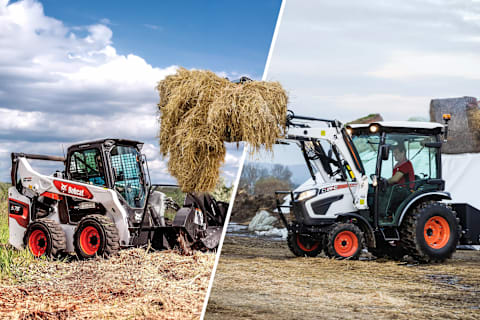
Many buyers assume a compact tractor and a skid-steer loader are simply two sizes of the same machine. They are not. A compact tractor steers its front wheels and delivers power through a power take-off (PTO) shaft and three-point linkage, the layout farm equipment has used for generations.
A skid-steer loader instead drives the wheels—or tracks on a compact track loader—at different speeds on each side. Trade press traces this differential, or "skid," steering back to Bobcat's own 1962 M440, the machine that created the category. That difference explains almost everything else here: it lets a skid-steer loader spin on the spot and pass through a doorway a tractor cannot reach, and it is also what tears up soft ground and scuffs concrete when the machine turns. A compact track loader keeps the same steering principle but trades some maneuverability for wider ground contact on soft or sloped terrain.
| Machine | EU example model | Rated operating capacity | Standard hydraulic flow | Steering type |
|---|---|---|---|---|
| Compact tractor | Bobcat CT2525 | 1 030 kg lift at the pivot point | 39.6 l/min (steering plus attachments) | Front-wheel steer |
| Skid-steer loader | Bobcat S590 | 979 kg | 64.7 l/min (101.1 l/min with High Flow) | Differential steer, wheeled |
| Compact track loader | Bobcat T590 | 971 kg | Auxiliary hydraulics standard | Differential steer, tracked |
Which Machine Actually Fits Through Your Gate, Doorway, or Barn?
Building and yard geometry decide this purchase before any spec sheet does. Mixed arable and livestock operations with low-roofed buildings often find their existing telehandlers can no longer fit through them, an opening that rules out a bigger machine regardless of what it could lift. Farms clearing old manure systems through a narrow barn doorway commonly shortlist the smallest wheeled skid-steer loader in the range, such as the Bobcat S70, on footprint alone. Before comparing lift capacity or engine power, measure the following:
- Doorway height and width at your narrowest regular entry point.
- Ceiling clearance in the building you use most, including any low beams or roof trusses.
- Turning space in your yard, since a compact tractor's longer wheelbase and wider turning radius can rule it out of exactly the buildings a skid-steer loader is built to enter.
Mowing: PTO Deck or Hydraulic Flail, Which Suits Your Ground?
A compact tractor's power take-off was built for mowing, and Bobcat's mid-mount mower attaches directly to a range of its compact tractor models to cut large areas efficiently, including tight corners a wider machine cannot reach. Fitting a flail or mulching head to a skid-steer loader is a genuine, working setup rather than a theoretical one. Operators running mulchers mounted on a skid-steer loader report limited ground impact even in heavy rain, but the reports converge on the same mechanical point: hydraulic power has to be split between driving the machine and running the mowing head, and a separate hydraulic pump is often needed to keep flow adequate once a head is added. Output drops noticeably in wet conditions. For large, regular grass cutting, a compact tractor and mid-mount mower stays the simpler match. For rough ground alongside other loader work, a properly plumbed flail head earns its place.
Hauling and Road Use: Where the Tractor's Drawbar Still Wins

Hauling and Road Use: Where the Tractor's Drawbar Still Wins
This is where the two machine types diverge. Bobcat builds a factory EU road-registration kit for specific skid-steer loader models, fitting a beacon light, headlights, mirrors, a horn, an electro-hydraulic lift arm lock, hazard, turn, and brake lights, a warning triangle, and a plate light, so those machines can drive and work on public roads across the EU.
That confirms the machine itself can be road-legal. It does not confirm it can tow a loaded trailer the way a compact tractor's drawbar can. For on-site handling rather than road transport, the balance flips: contractors comparing a skid-steer loader against a tractor, loader, and trailer combination for winter pallet work often judge the loader faster, even though the tractor combination is what makes the road journey. Choose the tractor for the road leg, and don't assume a skid-steer loader can replace it there.
Ground Damage, Stability, and Comfort: The Cost of Differential Steering
Differential steering is what makes a skid-steer loader agile, and it is also what damages the ground it turns on. Owners describe the same mechanism independently: the machine tears up soft ground or scuffs its tires on concrete when it turns, and experienced operators judge a rigid skid-steer loader unsuitable on wet, soft, or low-clearance terrain. Where tracked and wheeled variants are compared directly, the pattern holds: wheeled skid-steer loaders stay more agile on hard yards and roads, while compact track loaders are more stable and powerful for the same weight but slower to maneuver, and terrain, not preference, decides between them. Stability during lifting is a separate limitation worth naming on its own. Skid-steer loaders are shorter and more compact than other loader types, so less counterweight is needed to tip them forward under a raised load, and safety guidance recommends straightening the machine and lowering the load before any turn. Ride comfort can also feel less refined than a compact tractor's cab on long jobs, and it is worth checking that rated lift capacity on smaller skid-steer loader models is genuinely sufficient for round bales rather than assuming it.
What It Actually Costs, and Which Machine to Buy First
Purchase price for a well-specified skid-steer loader starts in the same broad range as a mid-size compact tractor, so price alone rarely settles the decision. Running costs are where the loader class carries expenses a compact tractor does not:
- Tire wear tied directly to differential steering, reported by owners as needing replacement anywhere from roughly once a year to once every two years, depending on ground conditions.
- Attachment breadth, the loader class's clearest value argument: one carrier running buckets, forks, sweepers, snow blades, and a mowing head spreads its purchase cost across far more jobs. The most convincing evidence comes from owners who run both machines and describe genuinely separate use rather than one replacing the other. A skid-steer loader is often called "irreplaceable, does everything" for daily manure, bale, and yard work, while owners running both machine types put it plainly: one "can't replace the other" for the jobs it actually does. Buy the machine that matches your most frequent task first, and treat the second as a genuinely different tool.
FAQ – Frequently Asked Questions
Is a Bobcat skid-steer loader road-legal in the EU?
Bobcat builds a factory EU road-registration kit for specific skid-steer loader models, adding lights, mirrors, a horn and a hydraulic lift arm lock so the machine can drive and work on public roads. It confirms the machine's own road-legal status, not its ability to tow a loaded trailer.
Does a skid-steer loader damage pasture more than a compact tractor?
On wet, soft, or low-clearance ground, yes. Differential steering scuffs and tears the surface when the machine turns, which is why experienced owners judge rigid skid-steer loaders unsuitable for soft terrain and recommend a compact track loader or a compact tractor instead.
Can a skid-steer loader run a flail mower or mulching head?
Yes, this is a genuine working setup used across Europe, but hydraulic power has to be split between driving the machine and the mowing head, and a separate hydraulic pump is often needed to keep flow adequate once a head is added.
Compact tractor or skid-steer loader, which should I buy first?
Buy the machine that matches your most frequent task. Owners who run both describe genuinely separate use rather than one replacing the other, so the second machine is worth adding once a specific job, mowing, hauling, or material handling, is regularly limited by the first.
Sources and Further Reading
- Compact Tractors – Bobcat Company Europe
- CT2525 Compact Tractor – Bobcat Company Europe
- S70 Skid-Steer Loader – Bobcat Company Europe
- S590 Skid-Steer Loader – Bobcat Company Europe
- T590 Compact Track Loader – Bobcat Company Europe
- Auger Attachment – Bobcat Company Europe
- Mid-Mount Mower – Bobcat Company Europe
Disclaimer
This content is provided for general informational and guidance purposes only. It may not reflect the specific requirements, conditions, configurations, attachments, applications, terrain, weather, or operating environment relevant to every machine or situation. Any models, configurations, availability, features, and specifications mentioned are provided for illustrative purposes only and may vary by market, region, dealer, and time. Operators, owners, and customers should always assess the actual working conditions and refer to the applicable operator’s manual, service manual, technical documentation, safety instructions, and product specifications for the specific Bobcat model and equipment being used. They should also consult an authorized Bobcat dealer or qualified professional before making operational, maintenance, purchasing, or safety-related decisions.