- Home
- Buyer's Guides
- Product Buyer's Guides
- Compact Tractor Ground Maintenance: Box Blades, Rakes, Snow Blowers, and Zero-Turn Mowers
Compact Tractor Ground Maintenance: Box Blades, Rakes, Snow Blowers, and Zero-Turn Mowers
Published on: 5 October 2026
In this article:
- A compact tractor's box blade, rake, and snow blade attachments cover routine ground maintenance across three seasons, while a zero-turn mower is built mainly for one job: cutting grass quickly.
- Attachment compatibility varies by model and by task, so checking which attachments actually fit a given compact tractor matters more than comparing headline horsepower.
- The right choice between a compact tractor and a zero-turn mower for ground maintenance work generally comes down to how many different jobs the machine needs to do across the year, not which one mows fastest.
Ground maintenance contractors, smallholders, and grounds teams often reach the same fork in the road: buy a compact tractor that can run a box blade, a rake, and a snow blade across the year, or buy a zero-turn mower that mows faster but does little else. This guide sets out what each attachment actually does, which compact tractor models support them, and how to weigh a compact tractor's versatility against a zero-turn mower's mowing speed before you commit to a purchase.
What counts as ground maintenance work for a compact tractor?

What counts as ground maintenance work for a compact tractor?
Ground maintenance covers the routine upkeep of driveways, tracks, paddocks, sports turf, and site access roads: leveling ruts, clearing debris, cutting grass, and removing snow. A compact tractor handles this work through interchangeable rear- and mid-mounted attachments rather than a single fixed deck.
Buyers frequently confuse two attachment families that solve different problems. A box blade collects and carries loose material such as gravel or spoil, which makes it the right tool for reshaping a driveway or filling ruts. A rake or grading attachment instead redistributes material that is already roughly level, which suits routine surface tidying rather than reconstruction work. Choosing the wrong one first is a common and avoidable cost.
Bobcat's compact tractor range uses the Bob-Tach™ quick-attach system, so an operator can move between a box blade, a rake, and a snow blade attachment without specialist tools. For a business running mowing in summer and grading or snow clearance in the shoulder seasons, that swap speed turns one chassis into several machines.
Compact tractor or zero-turn mower: which fits your ground maintenance workload?
A zero-turn mower is built around one task: cutting grass as quickly and maneuverably as possible. Independent trade testing comparing a zero-turn against a tractor-style mower over the same area found the zero-turn markedly quicker, and its tight turning radius suits properties with borders, trees, and other obstacles.
A compact tractor trades some of that mowing speed for range. The same chassis that mows with a mid-mount mower can also pull a box blade through a driveway or lift a rear snow blower onto the three-point linkage, jobs a zero-turn mower cannot do at all. Operators managing equestrian arenas or unpaved tracks need a machine that can tow and lift, not just cut.
| Consideration | Zero-turn mower | Compact tractor |
|---|---|---|
| Mowing speed and maneuverability | Faster, tightest turning circle | Slower on open turf |
| Attachment range | Mowing and light collection only | Grading, snow clearance, loader, and towing attachments |
| Ground conditions | Best on established, load-bearing turf | Turf tyres for lawns or agricultural tyres for grading and towing |
| Typical buyer | Mowing-only contracts, smaller lawns | Multi-season contracts, paddocks, mixed hard and soft ground |
Ground protection matters too. A compact tractor fitted with agricultural tyres for grading or towing will compact or mark soft turf if driven straight onto a lawn, so fitting turf tyres or timing mowing for drier ground avoids that damage. Buyers running a business in some markets should also confirm local registration and certification rules for commercial use of a compact tractor, since these can differ from the rules for a ride-on or zero-turn mower.
Which technical factors decide the right box blade, rake, or snow attachment?
Four factors decide which attachment a given compact tractor can run effectively, and which one is worth buying first.
- Power take-off and hydraulic capacity. A rear snow blower draws power more continuously through heavy or wet snow than a box blade or rake needs, so confirm an attachment's stated power requirement against the tractor's rear PTO output before ordering.
- Number of hydraulic remotes. Attachments with float or angle functions, such as a grading blade, work best with double-acting remotes that can lock the attachment in position; a tractor with a single remote pair may need to run those functions manually.
- Snowfall pattern. A snow blade or pusher style attachment is simpler, cheaper, and faster to fit for routine light to moderate snowfall, while a powered snow blower earns its higher cost and extra moving parts mainly where snow is heavy, drifting, or has nowhere to be pushed.
- Mounting position. Front-mounted blades generally clear snow more effectively than rear-mounted ones on the same tractor, since the operator can see and steer directly into the material being moved, whereas rear linkage remains the standard position for grading and leveling work.
Which attachments actually fit which compact tractor?
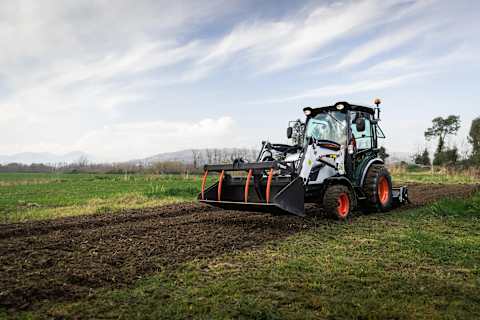
Which attachments actually fit which compact tractor?
Attachment compatibility is not uniform across the compact tractor range, and checking it against your specific model matters more than comparing headline specifications.
| Attachment | Compact tractor compatibility |
|---|---|
| Box blade | All compact tractor models |
| Rake | Most compact tractor models |
| Snow blade | All compact tractor models |
| Rear snow blower | All compact tractor models |
| Mid-mount mower | Most compact tractor models, excluding the two largest, highest horsepower tractors in the range |
Two naming points are worth flagging before you order. Bobcat's landscape rake attachment is built for skid-steer loaders, compact track loaders, and telehandlers rather than for compact tractors; compact tractor owners instead use the rake attachment designed specifically for the CT range for debris clearing and light surface tidying. Similarly, the snow pusher attachment is a loader and telehandler attachment. Compact tractor owners clearing snow should specify a snow blade or a rear snow blower instead, both of which are built for the full compact tractor lineup
Other compact tractor manufacturers offer comparable attachment ecosystems of varying breadth, so it is worth confirming compatibility against the exact model you are buying rather than assuming every attachment fits every tractor in a range.
Using a compact tractor for vineyard and orchard row maintenance
Row maintenance in a vineyard or orchard adds a constraint that open ground does not: row spacing limits how wide a tractor can be before it damages vines, trellises, or low branches. Growers on forums discussing this decision consistently work the calculation backward from row width and headland turning space rather than from horsepower, so measure your actual rows before checking a specific compact tractor model's width and turning radius against them.
Once fit is confirmed, the same ground maintenance attachments already covered in this guide carry over directly to row floor upkeep. A box blade keeps access tracks and headlands level, a rake clears prunings and other debris from the row floor, and a mid-mount mower manages the grass or cover crop strip between rows; a tiller or seeder can prepare and reseed that strip in the same pass. On sloped vineyard or orchard sites, the ballast considerations already covered above matter more, not less, since a loaded rear attachment shifts the tractor's center of gravity on an incline.
How should you budget for grading and snow attachments?
Grading and snow clearing are seasonal jobs, and how often you actually need them should drive the buy, hire, or build decision more than the sticker price of any single attachment. A contractor grading a track or clearing snow every week through winter recovers the cost of a purpose-built attachment quickly. An owner who grades a driveway once or twice a year may find hiring a contractor, or borrowing time on a neighbor's equipment, more cost-effective than owning a dedicated attachment that sits idle for most of the year.
Weigh resale value too. A compact tractor running general-purpose attachments such as a box blade or a rake tends to hold value better than a single-purpose mower, since the next buyer can put the same attachments to use.
Pre-purchase checklist
Before signing a contract for a compact tractor and its ground maintenance attachments, confirm the following:
- The exact attachment compatibility list for your specific tractor model, not just the range as a whole.
- The number and type of hydraulic remotes fitted, and whether your chosen attachments need double acting or float function.
- Whether the tyres supplied are agricultural or turf pattern, and whether you need both for mowing and grading work.
- Local registration, insurance, and licensing requirements for commercial use of a compact tractor in your market.
- Dealer proximity and warranty terms, since attachment swaps and servicing both depend on local support.
- Storage space and attachment swap time if the tractor will be used for more than one job type through the year.
Conclusion
There is no single right answer between a compact tractor and a zero-turn mower for ground maintenance work; the right choice depends on how many different jobs the machine needs to do. A property that only needs grass cut quickly and often is usually better served by a zero-turn mower. A business or smallholding that also grades tracks, clears snow, or tows equipment across paddocks gets more long-term value from a compact tractor's attachment range, provided the attachments chosen are confirmed as compatible with the exact model bought. Whichever route suits your workload, checking compatibility, hydraulic capacity, and local registration rules before ordering will save more time than comparing horsepower figures alone.
FAQ – Frequently Asked Questions
What is the difference between a box blade and a rake attachment on a compact tractor?
A box blade collects and carries loose material, which makes it suited to reshaping a driveway or filling ruts. A rake redistributes material that is already roughly level, so it works best for routine surface tidying rather than reconstruction. Buying the wrong one for the job is a common and avoidable cost.
Is a zero-turn mower or a compact tractor faster at mowing?
A zero-turn mower is generally faster at mowing than a compact tractor fitted with a mid-mount mower, and it also turns more tightly around obstacles. A compact tractor trades some of that mowing speed for the ability to run grading, snow clearance, and towing attachments on the same chassis.
Which attachments can be fitted to a compact tractor for snow clearance?
Compact tractor owners typically choose a snow blade or a rear snow blower, both of which are built for the full compact tractor line-up. The snow pusher attachment is designed for loaders and telehandlers rather than compact tractors, so it is not the right specification for a compact tractor buyer.
Does every attachment fit every compact tractor model?
No. The box blade, snow blade, and rear snow blower fit the full compact tractor range, but the mid-mount mower is not available for the two largest, highest horsepower models. Always check the compatibility list for your specific model before ordering an attachment.
When does a snow blower attachment make more sense than a snow blade?
A snow blade or pusher style attachment is simpler, cheaper, and faster to fit for routine light to moderate snowfall. A powered snow blower earns its higher cost mainly where snowfall is heavy, drifting, or has nowhere to be pushed.
Should I buy or hire a grading attachment if I only need it occasionally?
If grading or snow clearing is a weekly job through the season, owning a purpose-built attachment usually pays for itself quickly. If you only need the work done once or twice a year, hiring a contractor can be more cost effective than owning an attachment that sits idle for most of the year.
Do compact tractors need different registration or licensing than a zero-turn mower?
In some markets, using a compact tractor commercially can require registration, insurance, or certification that does not apply to a ride-on or zero-turn mower, even for identical ground work. Check the rules that apply where you operate before finalizing a purchase, since this can affect the total cost of ownership.
Sources and Further Reading
- Compact Tractors – Bobcat Company Europe
- CT2025 Compact Tractor
- CT2535 Compact Tractor
- CT4058 Compact Tractor
- Box blade
- Landscape rake
- Rear snow blower
- Snow blade
- Snow pusher
- Mid-mount mower
- ZT3000 Zero-Turn Mower
- Mowers – Bobcat Company Europe
- Compact tractor attachments
- Compact tractors for ground maintenance
- Compact tractors for agriculture
- Bobcat introduces new compact tractor lineup
- Bobcat launches new line of mowers for professional use
Disclaimer
This content is provided for general informational and guidance purposes only. It may not reflect the specific requirements, conditions, configurations, attachments, applications, terrain, weather, or operating environment relevant to every machine or situation. Any models, configurations, availability, features, and specifications mentioned are provided for illustrative purposes only and may vary by market, region, dealer, and time. Operators, owners, and customers should always assess the actual working conditions and refer to the applicable operator’s manual, service manual, technical documentation, safety instructions, and product specifications for the specific Bobcat model and equipment being used. They should also consult an authorized Bobcat dealer or qualified professional before making operational, maintenance, purchasing, or safety-related decisions.