- Home
- Buyer's Guides
- Product Buyer's Guides
- Compact Tractor Seasonal Prep: A Winterizing and Harvest-Readiness Guide
Compact Tractor Seasonal Prep: A Winterizing and Harvest-Readiness Guide
Published on: 8 October 2026
In this article, you’ll find:
- A step-by-step checklist for winterizing a compact tractor, from coolant and battery care to fuel selection and attachment switch-over.
- How to prepare a compact tractor for harvest, including pre-harvest floor cleanup and towing checks for vineyard and orchard rows.
- The safety warnings, common mistakes, and post-completion maintenance steps that keep a compact tractor reliable through the season change.
A compact tractor rarely fails at a convenient moment. It fails on the first frosty morning of the season, or in the final push before harvest, when there is no slack in the schedule to fix it. Seasonal prep exists to move that failure earlier, into a controlled inspection, rather than later, into a breakdown. This guide covers both directions of the seasonal transition: winterising a compact tractor for cold-weather lay-up or continued winter work, and preparing one for harvest, including the row-crop realities of vineyard and orchard operations.
Who should use this guide?

Who should use this guide?
Any compact tractor operator facing a seasonal transition can use this guide: arable and livestock farms, grounds and estate maintenance teams, and vineyard or orchard growers who sometimes assume seasonal checklists only mean snow and skip the parts that apply to them.
A compact tractor's job changes with the season more than most machines: the same tractor that mows and hauls through summer may run a snow blower in January and a mower or trailer again by autumn. Bobcat's compact tractor range spans a wide horsepower band with hydrostatic, manual, or H-Shuttle transmission options and a choice of ROPS or deluxe cab, so one machine can cover that full range rather than needing a second, specialised unit.
What equipment and parts should you gather before you start?
Confirm you have the right fluids, attachments, and dealer support lined up before starting. Working through the list once, rather than mid-task, avoids the most common cause of delay: a missing part or fluid discovered after the tractor is already partly stripped down.
- Genuine, pre-mixed coolant rated for your regional low temperature, rather than a concentrate you dilute yourself. Bobcat PreMix Coolant is supplied ready to use with freeze protection to minus 36 degrees Celsius, removing the guesswork of an incorrect dilution ratio.
- Hydraulic and hydrostatic fluid formulated for cold-weather pumpability, so the system responds normally at start-up.
- Low-ash engine oil suited to your service interval.
- Winter-grade diesel matched to your region's cold-filter plugging point, plus awareness of your AdBlue system's cold-weather behaviour.
- A genuine battery, glow plugs, and terminal protection appropriate to the length of your lay-up.
- The attachments the next season requires: a rear snow blower, box blade, and rake for winter ground work, or a finishing mower or mid-mount mower for pre-harvest floor cleanup, ideally paired with a front linkage interface so attachments switch quickly rather than requiring a full changeover job.
- A booked BobCARE inspection slot, timed before the season's peak workload rather than during it.
How do you winterize a compact tractor step by step?
Winterizing closes off the failure points that cold weather exposes one by one.
- Refresh the coolant. Confirm the freeze rating matches your climate rather than assuming last year's mix still holds, and use a pre-mixed, genuine coolant instead of diluting a concentrate on-site, since an incorrect ratio is a documented cause of cooling system damage.
- Check the battery and glow plugs. Decide whether to remove the battery, fit a maintainer, or leave it connected, based on lay-up length and storage temperature. Clean and protect the terminals either way.
- Switch to cold-rated hydraulic fluid. A subzero-pumpable hydraulic and hydrostatic fluid keeps loader and three-point hitch response consistent on cold mornings.
- Change attachments for the season. Where the tractor supports a front linkage interface, use it to move between dirt-season and snow-season attachment without a full changeover.
- Protect tires and storage. Check tread and pressure, and if the tractor sits outside or in an unheated shed, cover the exhaust outlet; snowmelt running down an uncovered muffler into the manifold is a real and avoidable cause of seized engines.
How do you prepare a compact tractor for harvest, including vineyard and orchard rows?
Harvest prep is a narrower window, and for vineyard and orchard operations it has to account for row access and towing loads that a general checklist does not cover.
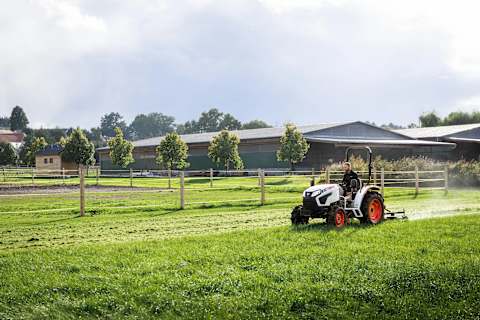
- Clear the row or field floor first. Switch to a finishing mower or mid-mount mower ahead of harvest to manage cover crops and ground growth between rows, using a front linkage interface for a fast attachment change.
- Confirm PTO and remote valve match. Before running any driven attachment, check PTO speed and rear remote valve count suit that attachment rather than assuming compatibility.
- Check the towing setup before you load it. Verify hitch condition, braking, and tyre pressure before hauling a trailer or supporting mechanised harvest equipment. Ballast adequate for routine fieldwork is not automatically adequate for a heavier harvest load.
- Book dealer service ahead of the peak. A BobCARE inspection scheduled before harvest catches issues a visual check will not, without competing for a slot once the season is already underway.
- Adjust the timing to your climate. Mediterranean vineyard and orchard operations have little frost to plan around and can focus on row clearance, hydraulics, and towing checks. Colder, more northerly operations often need harvest prep and winterizing to happen almost back-to-back as autumn turns cold.
| Region type | Main pre-harvest priority | Frost-related steps needed |
|---|---|---|
| Mediterranean vineyard or orchard | Row and floor clearance, towing and hydraulic checks | Minimal |
| Colder, more northerly arable or mixed farm | Harvest logistics plus early winterizing | Full coolant, fuel, and battery checklist |
What mistakes do operators most often make during seasonal prep?
What mistakes do operators most often make during seasonal prep?
Most seasonal-prep failures trace back to a small number of repeated mistakes rather than unpredictable faults.
| Mistake | Why it happens | Fix |
|---|---|---|
| Diluting coolant concentrate by guesswork | Assuming any top-up equals a full refresh | Use a genuine, pre-mixed coolant rated for your climate |
| Leaving attachment changeover too late | Treating it as a full changeover job | Use a front linkage interface to swap attachments ahead of need |
| Skipping a pre-harvest dealer inspection | Assuming a visual check is sufficient | Book BobCARE service before, not during, peak season |
| Storing outdoors without exhaust protection | Underestimating snowmelt and moisture ingress | Cover the exhaust outlet and check axle stands or tire pressure |
| Assuming existing ballast covers harvest towing | Ballast suited for routine fieldwork, not heavier hauling | Recheck hitch, brakes, and ballast against the actual load |
What safety warnings apply to seasonal compact tractor work?
- Cold conditions increase electrical and fuel-system fault risk at start-up. Inspect battery, cabling, and glow plugs before relying on a cold start rather than after one fails.
- Always disengage the PTO and apply the parking brake before connecting or changing a rear-mounted attachment.
- Use the ROPS or cab as fitted, and keep it in place; it is your protection in the event of a rollover.
- On sloped vineyard or orchard rows, know your tractor's stability characteristics before working an incline, particularly with a narrow or articulated chassis. Reduce speed, avoid sharp turns, and confirm ballast and attachment weight suit the terrain.
- Frozen or icy ground reduces traction and braking distance; adjust speed and following distance accordingly, especially when towing.
- After outdoor storage, check the exhaust and engine bay for nesting debris before starting, since blocked exhaust components are a fire and carbon monoxide risk.
What maintenance should follow completion of seasonal prep?
Seasonal prep sets up the maintenance record that carries the tractor into the next season change. Book the machine into BobCARE, Bobcat's planned maintenance program, so inspections continue year-round rather than only around seasonal transitions. Bobcat's standard maintenance schedules are structured around operating hours, so a seasonal check is a useful addition to that plan, not a replacement for it. Confirm your warranty position at the same time: the standard warranty covers 24 months or 2,000 hours, and Protection Plus can extend that up to 5 years or 6,000 hours. Keep a simple log of fluid changes, attachment switches, and dealer visits so you can confirm what was actually done before the season that just ended.
FAQ – Frequently Asked Questions
When should you start winterizing a compact tractor?
Timing depends on your climate. Colder, more northerly operations should generally start before the first hard frost, while Mediterranean vineyard and orchard operations may need only minimal frost-related preparation and can focus timing around harvest instead.
Can you dilute concentrated coolant yourself instead of buying a pre-mixed product?
You can, but an incorrect dilution ratio is a documented cause of cooling system problems. Using a genuine, pre-mixed coolant rated for your regional low temperature removes that risk entirely.
Does a compact tractor need a block heater for cold winters?
Not always. Many operators manage reliable cold starts with correct coolant protection, a healthy battery, and winter-grade diesel alone; a block or coolant heater becomes more relevant in the coldest regions or for very early starts.
How do you prepare a compact tractor for pre-harvest work in vineyard or orchard rows?
Switch to a finishing mower or mid-mount mower for row and floor cleanup, confirm PTO speed and remote valve count match your attachment, and check hitch, brakes, and ballast before towing harvest trailers or supporting mechanised harvest equipment.
Is it safe to operate a narrow tractor on sloped vineyard or orchard rows?
Only with attention to your specific tractor's stability characteristics. Reduce speed on inclines, avoid sharp turns, and confirm ballast and attachment weight suit the terrain rather than assuming a narrow or articulated configuration is stable on every gradient.
Should seasonal prep be done DIY, or is a dealer inspection necessary?
Fluid checks, battery care, and attachment switching are reasonable DIY tasks. A dealer's diagnostic tools can catch issues a visual check will miss, so book that inspection before peak season rather than during it.
What warranty protection applies if something fails during a demanding season?
Bobcat's standard warranty covers 24 months or 2,000 hours. Protection Plus can extend that coverage to 5 years or 6,000 hours.
Disclaimer
This content is provided for general informational and guidance purposes only. It may not reflect the specific requirements, conditions, configurations, attachments, applications, terrain, weather, or operating environment relevant to every machine or situation. Any models, configurations, availability, features, and specifications mentioned are provided for illustrative purposes only and may vary by market, region, dealer, and time. Operators, owners, and customers should always assess the actual working conditions and refer to the applicable operator’s manual, service manual, technical documentation, safety instructions, and product specifications for the specific Bobcat model and equipment being used. They should also consult an authorized Bobcat dealer or qualified professional before making operational, maintenance, purchasing, or safety-related decisions.