- Home
- Buyer's Guides
- Product Buyer's Guides
- How to Use Bobcat Equipment for Forestry Work: A Buyer's Guide to Forestry Attachments
How to Use Bobcat Equipment for Forestry Work: A Buyer's Guide to Forestry Attachments
Published on: 10 November 2026
In this article:
- You will learn how one Bobcat loader handles tree transplanting, vegetation management, land clearing, and woodland maintenance.
- You will discover how the Bobcat tree transplanter digs, lifts, and moves a tree without the operator leaving the seat.
- You will understand what the Bobcat forestry kit protects and when your loader needs it.
Forestry work is rarely one job. You clear brambles in spring, open up woodland rides in summer, and move young trees in the dormant season. A dedicated machine for each task means more capital tied up and more machines standing idle. This guide shows how a Bobcat skid-steer loader or compact track loader handles all of it, with the right attachment and the right protection.
Why use a compact loader for forestry work?
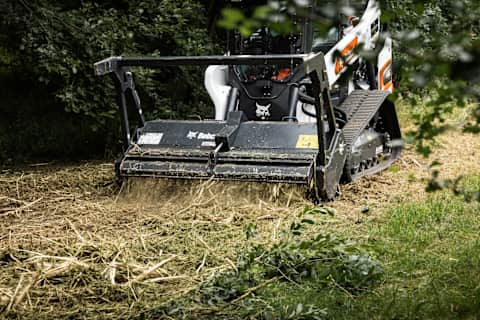
Why use a compact loader for forestry work?
- A Bobcat loader becomes a different forestry machine every time you change the attachment on the Bob-Tach™ coupler.
- Bobcat offers more than 120 attachments, and many of them work across several Bobcat carriers.
Woodland jobs change throughout the year, so a dedicated mulcher, stump grinder, or tree spade sits idle for most of it.
Bobcat builds its compact loaders as tool carriers. The loader and its attachments move between sites without the special transport a large dedicated forestry machine needs. The compact size of a Bobcat loader lets the operator slalom between trees to reach the cutting area without damaging the vegetation you want to keep.
Ground conditions decide the undercarriage. Operators report that wheeled compact loaders get stuck on wet woodland ground. Bobcat recommends a compact track loader for soft or sensitive ground and a skid-steer loader where agility counts on firmer ground.
Customer Experience
Magnus Leufstedt, operator at Magnus Thor AB, shares a practical tip for soft ground:
"Because the machine carries substantial front weight with attachments installed, we execute wide, gentle turns across the jobsite to avoid tearing up soft ground."
For you, that means one machine earning its keep in every season instead of several tools hired by the day.
Customer Experience
Large-scale forestry contractors need a machine that can switch jobs quickly. Joakim Persson, owner of Magnus Thor AB, which provides land clearing, site preparation, and seedling planting across Sweden, explains why the company chose a versatile Bobcat T86 compact track loader:
"Flexibility is core to our business model. Investing in a versatile base machine allows us to pivot quickly if project demands shift."
On a typical day, he adds:
"We frequently swap attachments throughout the day to match the task—transitioning between a forestry cutter, sweeper bucket, landscaper rake, timber grapple, and standard bucket."
Which Bobcat attachment fits which forestry job?
A cutter that is too light struggles with thick stems, while a large mulching head is hard to place around trees you want to keep. Match the attachment to what is growing on site.
| Forestry job | Bobcat attachment | What it does |
|---|---|---|
| Tree transplanting | Tree transplanter, convertible | Digs, lifts, and moves a tree with its root ball |
| Vegetation management | Flail cutter | Cuts overgrowth and follows the ground contour |
| Vegetation management | Brushcat™ rotary cutter | Cuts tough grass and brush, mulches small branches |
| Land clearing | Forestry cutter | Turns standing trees and underbrush into mulch |
| Land clearing | Root grapple | Picks up brush, roots, and logs while soil falls through |
| Stump removal | Stump grinder | Grinds stumps into mulch at different cutting heights |
| Woodland maintenance | Log grapple | Collects branches and logs after cutting |
Customer Experience
For Magnus Thor AB, the forestry cutter is where the loader saves the most work. Joakim Persson explains:
"It saves an enormous number of manual hours, particularly when operating the forestry cutter. Clearing dense, thorny brush or working in tight, hard-to-reach areas with manual brush cutters is extremely physically demanding. The machine eliminates that manual labor almost entirely."
Mulching alone leaves roots in the ground, which can cause issues when replanting. To clear the area completely, schedule a second pass with a root grapple. Its curved teeth lift material without digging into the soil, letting dirt fall through cleanly. Alternatively, you can run the forestry cutter below grade to blend mulch into the soil.
The right pairing takes a site from overgrown to ready for replanting in fewer passes.
How does the Bobcat tree transplanter work?
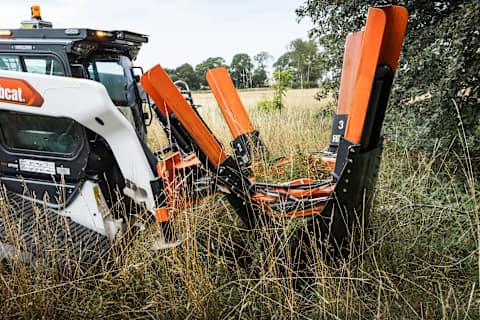
How does the Bobcat tree transplanter work?
- The Bobcat convertible tree transplanter digs, transplants, or packages a tree while the operator stays in the seat.
- Overlapping blades cut the roots cleanly and support the root ball as the tree is lifted.
Moving a tree with a bucket damages roots, while a dedicated tree spade requires significant down pressure to drive its blades into the soil.
| Blade type | Blade angle | Best for |
|---|---|---|
| Cone | 30° | Hard or sandy soils and lighter root balls |
| Modified (most popular) | 25° | A larger root ball for better root protection |
Three transplanter sizes let you match the root ball size to your loader and your trees. A swing-open gate and open-frame design provide easy access to the trunk. All functions are controlled electronically from the operator’s seat using either a pendant-style control panel—compatible with all Bobcat loader series—or a 7-pin control kit for G-Series and newer models.
The transplanter requires rear stabilizers, which means your loader needs rear auxiliary hydraulics. Stabilizers transfer machine weight onto the front attachment, keep the loader grounded, and level it on uneven terrain. The attachment is also compatible with Bobcat MaxControl, allowing you to align the blades around the trunk directly from the ground.
The result is a clean, well-supported root ball, and one operator can dig, move, and replant a tree without leaving the seat.
What does the Bobcat forestry kit protect?
- The Bobcat Forestry Applications Kit protects both the operator and the machine from flying objects and debris.
- The forestry cutter can only be used when the kit is installed on the loader, and the T590 compact track loader also needs a counterweight.
When you clear overgrown land, the biggest risk is thrown debris. Branches, stones, and hidden wire can hit the cab with real force, and a standard cab window is not built for that. Wood chips and dust also build up in the cooling package and can make the engine overheat on long mulching days.
The Bobcat forestry kit protects your cab first. It includes a laminated polycarbonate forestry door, and mulching attachments will not run until that door is fitted. If you open the cab door on a kit-equipped loader, a safety feature stops the attachment. The forestry cutter adds its own protection: a standard front gate reduces the material thrown forward, and a pressure gauge you can see from the seat helps you avoid overloading the head.
The kit does not replace routine maintenance. Always clear wood chips and leaves from the cooling package, and regularly inspect hydraulic couplers, hoses, and the exhaust area.
With the kit installed, your Bobcat loader can take on demanding clearing work while the operator and the machine stay protected.
Pre-purchase checklist
- Measure the largest stems and stumps on your site and compare them with each attachment’s capacity.
- Check whether your loader has standard flow or high-flow hydraulics.
- For transplanting, confirm rear auxiliary hydraulics and order rear stabilizers and a control kit.
- Choose a compact track loader if you work on soft or sensitive ground.
FAQ – Frequently Asked Questions
Can a Bobcat skid-steer loader do forestry work, or do I need a compact track loader?
Both can do forestry work with the right attachments. A compact track loader is the better choice on soft or sensitive woodland ground, while a skid-steer loader suits firm ground. Check the compatibility of each attachment with your model.
Do I need the forestry kit for every forestry attachment?
The Bobcat Forestry Applications Kit must be installed to run the forestry cutter, and the T590 also needs a counterweight. For other attachments, ask your dealer which cab protection is recommended for the work you plan to do.
What does the forestry kit include?
The kit protects the operator and the machine from flying objects and debris. It includes a laminated polycarbonate forestry door, and a safety feature stops the attachment when the cab door is opened.
What do I need to run the Bobcat tree transplanter?
You need a compatible loader with rear auxiliary hydraulics, rear stabilizers, and either a pendant control kit or a 7-pin control kit. The pendant version fits all Bobcat loader series, while the 7-pin version requires a G-Series or newer loader.
Which blade should I choose for the tree transplanter?
The cone blade suits hard or sandy soils and lighter root balls. The modified blade is the most popular and produces a larger root ball for better root protection.
Does a forestry cutter remove roots?
A forestry cutter turns trees and underbrush into mulch and can work below grade, but it does not pull out root systems. If you plan to replant or cultivate, follow up with a root grapple or stump grinder.
Sources and Further Reading
- Tree Transplanter, Convertible
- Forestry Cutter
- Get Powerful and Precise Tree Clearance with the Bobcat Forestry Cutter
- Forestry Attachments
- Rear Stabilizers
- Brushcat™ Rotary Cutter
- Flail Cutter
- Stump Grinder
- Grapple, Root
- Bobcat Expands Products for Summer Clean Up & Maintenance
- Bobcat: Creating The Best Match of Carriers & Attachments
Disclaimer
This content is provided for general informational and guidance purposes only. It may not reflect the specific requirements, conditions, configurations, attachments, applications, terrain, weather, or operating environment relevant to every machine or situation. Any models, configurations, availability, features, and specifications mentioned are provided for illustrative purposes only and may vary by market, region, dealer, and time. Operators, owners, and customers should always assess the actual working conditions and refer to the applicable operator’s manual, service manual, technical documentation, safety instructions, and product specifications for the specific Bobcat model and equipment being used. They should also consult an authorized Bobcat dealer or qualified professional before making operational, maintenance, purchasing, or safety-related decisions.