- Hogar
- Accesorios
- Spreader Attachments
SPREADER ATTACHMENTS
Take control of winter surfaces with spreaders built to deliver consistent coverage, less waste and safer traction in every pass.
MODELS
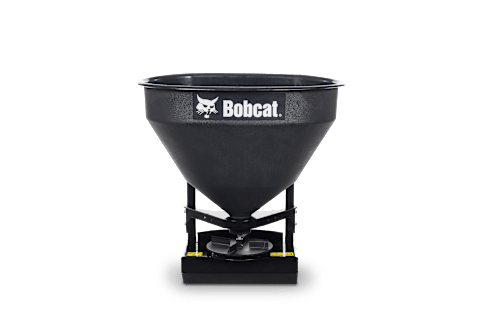
Distribuidor de transmisión de portones eléctricos
Escarificador de montaje frontal
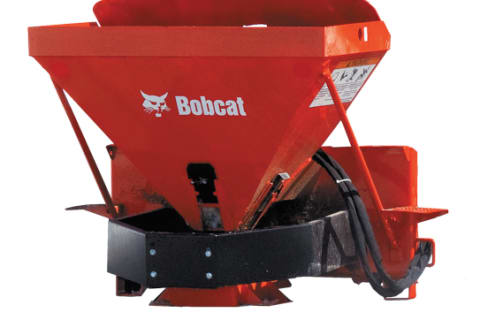
Esparcidor de arena y sal - HS8
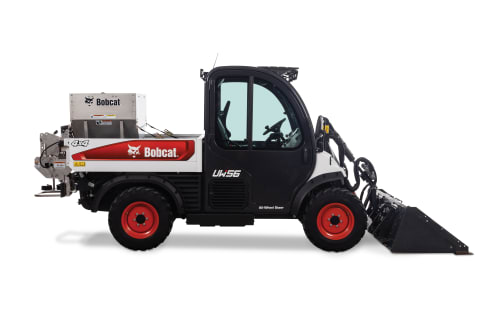
Esparcidor de arena y sal - SP13
Esparcidor de arena y sal - SP9
Esparcidor de caída - 2,5 pies cúbicos
Esparcidor de caída - 6,0 pies cúbicos
Esparcidor de transmisión de garganta
HOW TO CHOOSE A SPREADER
Buying a Bobcat spreader starts with two questions: what material are you applying and what machine are you running. In winter, that usually means sand, salt or a sand and salt mix for traction control. In spring, summer and fall, spreaders can also handle granular turf and property-care products – like fertilizer, seed and granular insect control products – when you need consistent coverage and less waste across lawns, campuses and large properties.
What is Your Carrier?
Pick the spreader designed for the machine you’re using most:
- HS8 spreader (compact loaders): Bob-Tach® system mounted and hydraulically powered for skid-steer loaders, compact track loaders, select telehandlers and Toolcat utility work machines.
- SP9/SP13 spreader (UTV & Toolcat): Cargo box-mounted spreaders built specifically for Bobcat utility vehicles and Toolcat utility work machines, with in-cab dash controls.
Choose the Spread Pattern That Fits the Season and the Site
Your route and material type should steer you toward broadcast vs. drop spreading:
- Broadcast spreaders are built to cover more ground quickly – a strong fit for parking lots, lanes, long drives and wide open areas where speed and coverage matter.
- Electric-Gate Broadcast Spreader: Choose this when you want more controlled starts or stops and more precise rate adjustment for changing conditions and materials.
- Throated Broadcast Spreader: Choose this for straightforward, rugged spreading when you want dependable performance with simple controls.
- Drop spreaders are built for tight, controlled placement – ideal for sidewalks, pathways, edges and areas where you don’t want product thrown into landscaping beds, streets or sensitive zones.
- 2.5 cu. ft. Drop Spreader: A compact option for tighter routes and smaller properties.
- 6.0 cu. ft. Drop Spreader: Step up when you want more onboard capacity to reduce refills on longer runs.
Match Capacity and Control to Your Route
- More capacity = fewer stops on larger properties and longer routes.
- More adjustability = less waste when wind, moisture and material type change.
- For lawn-care products (fertilizer, seed and granular insect control), tighter control helps you stay on-rate and avoid over-application.
Quick Checklist
- Season + material: salt and sand mix vs. Fertilizer, seed and granular insect control.
- Carrier: compact loader vs. Utility vehicle (UTV) and Toolcat utility work machine.
- Pattern needs: wide broadcast coverage vs. tight drop placement.
- Capacity: shorter routes vs. long runs with fewer refills.
- Control preference: electric gate control vs. straightforward mechanical control (by model).
FREQUENTLY ASKED QUESTIONS
What is a spreader attachment?
A spreader attachment is a machine-powered tool that meters and distributes granular material (most often sand or salt) to improve traction and reduce ice on roads, parking lots, sidewalks and pathways.
What are spreader attachments used for?
Bobcat spreader attachments are used to apply a range of granular materials, including:
- Winter traction materials: salt, sand and common sand or salt mixes.
- Turf and property-care products: fertilizer, seed and granular insect control products (by product label and local requirements).
- Material placement/topdressing: soil and similar materials (with the right spreader style for the job).
What types of spreader attachments are available?
In this category, Bobcat spreader options include:
- Sand and salt spreader attachments for winter traction control (loader-mounted and Utility Vehicles (UTV) or Toolcat utility work machine configurations depending on model).
- Broadcast spreaders (Electric-Gate Broadcast Spreader and Throated Broadcast Spreader) for wider-area coverage.
- Drop spreaders (2.5 cu. ft. Drop Spreader and 6.0 cu. ft. Drop Spreader) for tighter, more precise placement.
- Soil and asphalt Spreader for controlled placement of soil or asphalt materials on the jobsite.
How do I choose the right spreader attachment?
Start with the material, the site and the carrier:
- Material: salt and sand mixes for winter, or fertilizer, seed and granular insect control for turf, or soil and asphalt materials for placement and topdressing.
- Site layout: wide-open lots and lanes vs. sidewalks, paths and tight edges.
- Carrier: skid-steer loader, compact track loader, compact wheel loader, Toolcat utility work machine or Bobcat utility vehicle (by model).
As a simple rule:
- Broadcast spreaders cover ground fast across larger areas.
- Drop spreaders keep product tight to the target area with less overspread.
- Sand and salt spreaders are purpose-built for winter traction routes.
- Soil and asphalt spreaders are built for controlled placement of heavier materials.
How do I choose between spreaders?
Match the spreader to the job:
- Sand and salt spreader attachment: winter traction control on lots, lanes and routes where consistent coverage matters.
- Broadcast spreader (Electric Gate or Throated): faster coverage across larger areas when you want a wider pattern.
- Drop spreader (2.5 cu. ft. or 6.0 cu. ft.): controlled placement for sidewalks, edges and tighter zones.
- Soil and asphalt spreader: controlled placement of soil or asphalt materials where you need cleaner distribution and less handwork.
Are spreader attachments interchangeable or universal?
They’re not universal, but many Bobcat spreader attachments are designed for versatile compatibility across multiple carriers when the mount and machine requirements match. Depending on model, Bobcat spreader attachments may be compatible with skid-steer loaders, compact track loaders, compact wheel loaders, Toolcat utility work machines and Bobcat utility vehicles.
Interchangeability comes down to a few hard requirements:
- Carrier type and mounting interface (Bob-Tach vs. cargo box mounting and any model-specific mounting hardware).
- Hydraulic flow or pressure and electrical needs (if the spreader uses powered metering, augers or controls).
- Machine capacity and stability (the attachment has to match the carrier’s rated capability).
Bottom line: Bobcat spreader attachments are built to help you run a more flexible fleet, but true interchangeability depends on the exact carrier and configuration. Your local Bobcat dealer can confirm approved compatibility across your machines.
GALLERY
RELATED ATTACHMENTS
Abrazadera hidráulica - Brazo estándar, E26
Abrazadera hidráulica - E20
Sujete, levante, mueva y coloque más escombros con la potencia del accesorio de abrazadera (o pulgar).
Abrazadera hidráulica - E32 y E35, brazo extensible
Abrazadera hidráulica - E32R2 y E35R2, brazo estándar/largo
Abrazadera hidráulica - E42 y E45, brazo estándar
WHY BOBCAT ATTACHMENTS
Built for
Durability
Engineered with the highest quality standards and guaranteed to work with compatible equipment.
Local Dealer Support
Authorized local dealers provide trusted advice, parts, service, and support.
Peace of Mind
Standard two-year warranty for hydraulic attachments, plus available extended warranty for select attachments.
Best Value
Competitive attachment pricing, plus available 0% financing and other limited-time special offers.
Search Attachments & Implements
Explore More
Browse by Product
ADVERTENCIA: Este producto puede exponerlo a sustancias químicas, como gases de escape del motor (incluidos los de motores diésel, si están equipados), plomo y compuestos de plomo, aceites minerales, hollín, ftalatos y monóxido de carbono, que el Estado de California reconoce como causantes de cáncer, defectos congénitos u otros daños reproductivos. Para obtener más información, visite www.P65Warnings.ca.gov.
Algunas especificaciones se basan en cálculos de ingeniería y no corresponden a mediciones reales. Se proporcionan únicamente con fines comparativos y están sujetas a cambios sin previo aviso. Las especificaciones de su equipo variarán según las variaciones normales de diseño, fabricación, condiciones de funcionamiento y otros factores.