- Home
- Buying Resources
- Mowers
- How Do Zero-Turn Mowers Work?
HOW DO ZERO-TURN MOWERS WORK?
Why it matters.
Understanding how zero-turn mowers function is pivotal in making an informed buying decision, developing a consistent upkeep and maintenance routine, and ultimately assuring proper turf maintenance. Below you’ll find information regarding what a zero-turn mower is, how it functions, how it takes on various challenges and what applications zero-turn mowers are best suited for.
What makes a “zero-turn” a zero-turn?
A “zero‑turn” mower gets its name from its ability to pivot within its own footprint, delivering a true zero‑degree turning radius. Instead of steering like traditional ride‑on mowers (garden tractors) with a steering wheel, zero‑turn mowers use independently controlled rear wheels powered by hydraulic drive systems and its own transaxle.
Because each rear wheel can move at a different speed, or rotate in opposite directions, the mower can turn in place without moving forward or backward. This allows the mower to make tight 180‑degree turns at the end of a pass and even rotate a full 360 degrees "on a dime" when needed. The result is exceptional maneuverability around trees, landscaping, and other obstacles with minimal repositioning.
By eliminating wide turnarounds and unnecessary repositioning, zero‑turn technology allows for smoother mowing patterns, fewer passes, and reduced overall mowing time. This helps maintain a clean, professional‑looking cut while improving overall efficiency.
How is this different from a garden tractor or walk-behind mower?
The key point of differentiation between a zero-turn mower and a garden tractor or walk-behind mower is the turning radius. Whereas the mechanics of a zero-turn mower allow for a pivot within the machine’s footprint:
A garden tractor requires a standard T-turn to reverse or change direction for a full 180-degree turn-around. This may prove challenging in tight spaces or highly landscaped areas.
A walk-behind mower naturally offers the ability to pivot, however propulsion comes from the operator pushing and turning the mower physically and doesn’t offer the same comfort features as a zero-turn mower.
Key Components of a Zero-Turn Mower
Dual hydrostatic drive system
A dual hydrostatic drive system uses two independent hydraulic drives, one for each rear wheel, to control speed and direction. By varying hydraulic flow to each wheel independently, the mower can move forward, in reverse, turn smoothly or pivot in place. The system affords the operator precise control, smooth operation and consistency in power.
Drive and caster wheels
The drive wheels on a zero-turn mower are the two, larger back wheels and are powered through the hydrostatic drive system. Their primary responsibility is to provide propulsion for the mower. The front caster wheels are unpowered and swivel freely, supporting the front of the mower, allowing it to pivot smoothly when changing direction.
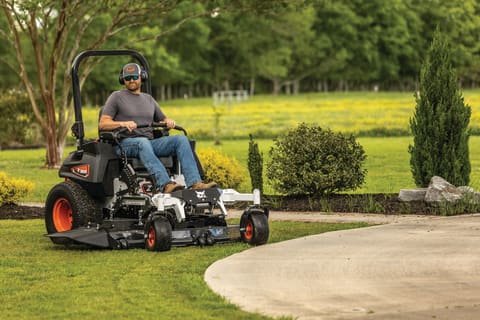
Control Levers
The left and right traction control levers (or bars) on a zero-turn mower replace the steering wheel and are required to achieve a true zero-turn pivot as each lever controls one drive wheel.
Cutting Deck
The cutting deck houses the blades and manages airflow to lift, cut and discharge grass cleanly and evenly. It’s positioned centered beneath the mower, keeping the center of gravity low and to provide for balanced cutting.
How does steering and movement work?
A zero‑turn mower uses traction control levers to control steering and movement rather than a traditional steering wheel.
The zero-turn mower is disengaged when the traction control levers are open, allowing the operator access to the seat. Steering and movement begin when the operators engage the traction control levers by pulling the levers inward, engaging the drive system.
Pushing both levers forward moves the mower straight ahead, while pulling them back reverses the mower. Moving one lever more than the other causes the mower to turn, right or left. Pushing one lever forward while pulling the other back allows the mower to pivot in place. This independent control of each rear wheel gives the operator control over speed and direction.
See the operation in action in our Turf Talks video with easy-to-follow step-by-step instructions.