Control and Accuracy Comparison
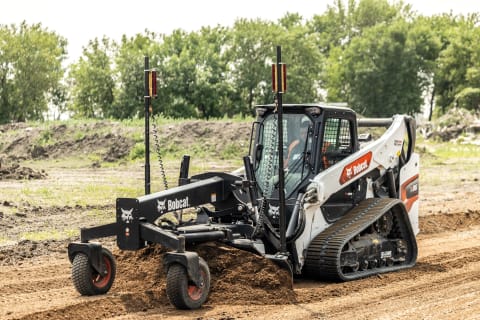
At this size class, you’re looking for a compact track loader with the power of a linebacker but the precision of a surgeon. The Bobcat T76 rises to the challenge. While the Cat 289D3 is content to settle for so-so controls, the Bobcat T76 gives you incredibly responsive selectable joystick controls that allow for super-precise movement, as well as drive lift/tilt compensation, speed management, steering drift and drive response.
Running the controls on the Cat model vs. the Bobcat loader feels like the difference between making it work (Cat) and relishing the joy of your work (Bobcat).
When it comes to relishing work, both the Bobcat and Cat compact track loaders excel at dual-direction attachment leveling – keeping the attachment on an even keel when the arms lift up as well as lower down. So neither machine will embarrass you by dropping a pallet of bricks at the wrong time or letting an expensive bucketload of animal feed slip on the way to the feeder.
However, only the T76 gives you the option – at the push of a button – to choose how you want to level your attachment: on the way up only or both up and down. You’re in control.
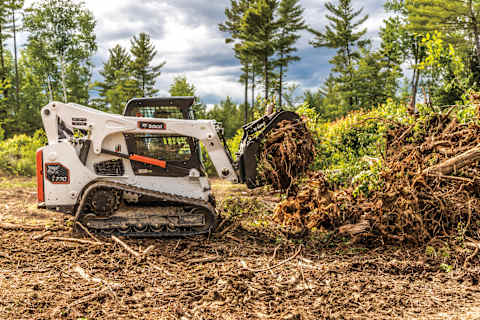
Visibility is key to safely and successfully operating a compact track loader, and here Bobcat has Cat beat. Not only does the Bobcat T76 come standard with bright LED lights perfect for nighttime construction jobs and low-light barn conditions, but the Bobcat model boasts you-have-to-see-it-to-believe-it views from the operator’s seat.
The T76 benefits from a new lift arm design featuring strong, slim cast-steel construction, which gives you a clear view to the cutting edge in front as well as side views down to the tracks. You can even opt for the clear-side enclosure option to get a better view of the jobsite all the way around.
By comparison, the Cat 289D3 comes with standard halogen front lights that lack the luminosity of LEDs, and a mesh-covered windowed cab.